Showing posts with label Read Alouds. Show all posts

Wednesday, July 5, 2017

Restart, by Gordon Korman


      Ever wanted to ride your tricycle through the carwash just to see what would happen?  Yeah, me neither.  But that's exactly what happened in an early scene of Gordon Korman's latest middle grades read, Restart.  And that scene is how I'm going to start my Book Talk for Restart when school starts up again.  Just the image of a boy riding through a carwash on a tricycle with a GoPro on his head, while his friend videos from the observation window!  I laugh every time, and it's what got my son interested in the book.

      Restart isn't really about insane children, although there are other funny scenes involving middle school YouTubers.  (Leaf Man, anyone?)  It's actually a refreshing story about a boy who wakes up with amnesia after being knocked out by a head injury.  
Image result for restart gordon korman
      Your heart really goes out to the kid - until he gets home and starts looking at the pictures on his phone.  There's a heart sinking moment for both the reader and the character as he realizes that although he doesn't remember it, he is the school's worst bully.  He knows that he needs to change his ways - but the question is, will he be able to?  Most kids in the school are terrified of him and may not give him another chance.  And the worst part is that he doesn't remember what he's done to kids, so he doesn't know what problems he needs to fix.

     The point of view is what makes this story great.  I think that it would have been tedious to read the book from the sole perspective of the bully.  However, each chapter is narrated by a different character - Chase the ex-bully, his former bully friends, and his former victims.  Each character has a different take on "old Chase" vs. "new Chase," and it's fascinating to watch his relationships with his classmates change.

      Plus, there's that tricycle scene....

      Highly recommended for any middle grader.  Most of them are going to react well to all the YouTube references.  And I think that boys especially are going to get a kick out of this book.  This would be great for either a read-aloud or a read-alone.
      

Sunday, July 2, 2017

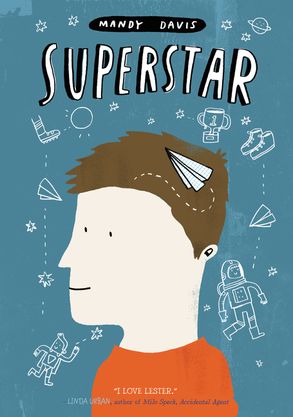
Superstar, by Mandy Davis

      Superstar is Mandy Davis' debut middle grades novel about a boy with high functioning Autism Spectrum Disorder (ASD).  Lester is a fifth grader who is starting his first year of public school after being homeschooled.  The book explores the challenges he faces as he adapts to new surroundings.

Image result for superstar mandy davis      I felt that the description of Lester's reactions to his world were accurate.  In that sense, there are students who would find this book interesting.  Lester has a very black and white take on everything, interpreting idioms such as "hold onto your hat" literally.  At the beginning of the novel, he really doesn't show any interest in the feelings of others.  His emotional outbursts in class are certainly reflective of his frustrations.

       Other parts of the book just didn't ring true for me.  First, a school cannot diagnose a child with any medical condition, let alone ASD.  That appears to be what happens in this book.  Coupled with the fact that it's vague as to whether Lester's mom knew he had ASD to begin with, the parts pertaining to Lester's IEP seemed strange to me.  Then there are oddities that don't happen in schools in my area - teachers leaving the class alone in the room, the resource teacher having a lot of free time with zero or one student.  That's the kind of thing my students question when we read a book together.

      One reviewer called parts of the book funny, but I'm not sure which parts those were.  The themes in this book are pretty intense, and I was just mostly concerned for Lester throughout the book.  On top of Lester's frustrations at school, his home life is also tough.  Lester's father, an astronaut, has died in a reentry accident.  His mother is overly protective of Lester as a result, and is dealing with grief and anxiety of her own.  These are tough themes in a middle grades book, and at times it seemed to be too much.

      I originally thought this book might be good to give to students who are themselves on the spectrum, or who have befriended students on the spectrum.  However, I felt that the book wrapped things up a little too neatly at the end.  Lester shows a remarkable turnaround after his IEP, and by the end of the book is acting largely like his autism is nearly cured.  The same goes for his mother's anxiety.  That might be frustrating for someone who is really struggling with autism and isn't getting such a happy ending in real life.  

      Who is the right student for this book?  This all being said, I think the book still has value in a classroom.  We're seeing so many more cases of ASD, and a book told from the perspective of an autistic student will help spread awareness.  It might serve better as a read aloud, since the issues in the book warrant discussion.  Beyond a read aloud, I'd reserve this book for students who are more mature, who are sensitive to the feelings of others, or who specifically want to know more about autism.  

      All in all, I applaud Mandy Davis for stepping out and writing a novel about this subject.  It is much needed.

Thursday, May 25, 2017

2016-2017 5th Grade Read Alouds

I'm a big fan of the read aloud - it clearly was a must-do when I taught primary grades.  But this last year, my first in 5th grade, I realized the value of a daily read aloud even for the "big kids".  Those wonderful little souls looked forward to our read aloud time after lunch every day.  Not only did it give them a chance to defrag from the drama of the lunchtime playground, but we loved to spend that time discussing books we'd read.  

Today, on the last day of school, I'd like to share what we read this year, in order from August to May.


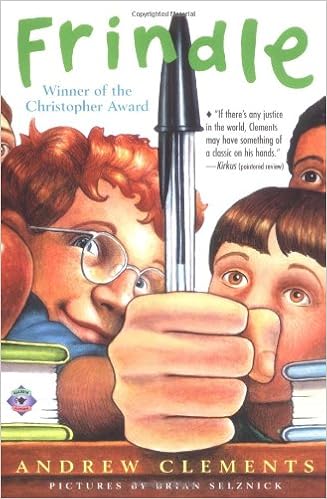
1.   Frindle, by Andrew Clements
      

Frindle was recommended by a teacher blog, and I'm ashamed to say I don't remember which one.  It was the perfect start to the school year.  It let my students know that I approve of creativity, and it prompted amazing discussions about words and how they are developed.  It also got us talking about the relationship of students and teachers.  We all got to know each other better as a result.


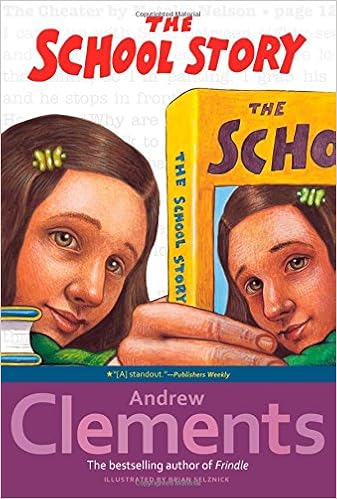
2. The School Story, by Andrew Clements

I capitalized on our love of Frindle by teaching the kids about using favorite authors to guide books choices.  "If you liked Andrew Clements, let's try some more of his books!" I told the class.  We chose The School Story together, and I admit I went into it sight unseen.  It had some powerful themes of friendship and love of family that went a long way in my class.  It also helped that we finished it right around the time the kids were publishing their first writer's workshop narratives.  They had more patience for the process because of what they learned about the publishing world in The School Story.


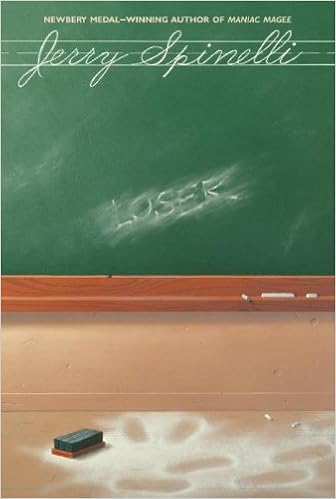
3. Loser, by Jerry Spinelli
Loser was recommended to me by my 5th grade colleague.  We were both new to the grade this year, and we really helped each other out.  As she read the book to her class and filled me in on the plot, I knew my kids needed to hear this book.  We had the most valuable to discussions about sweet Zinkoff and his naive independence.  And it taught many of the kids to have more tolerance of kids who just don't fit the mold set by the "popular" kids.  We referred to this book all year in social discussions.  I may start the year with this book next time around.


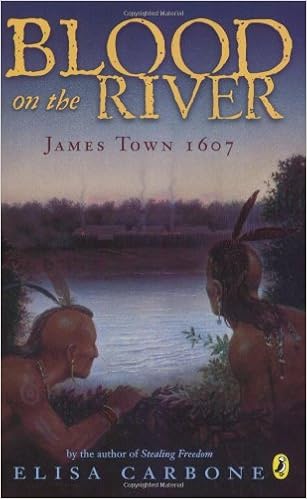
4. Blood on the River, by Elise Carbone

Another colleague recommended this one.  Just. Wow.  This was my favorite book that we read all year.  If there's a better book about the Jamestown colony, I haven't heard of it.  We absolutely loved this book - the kiddos were hanging on my every word, and the crossover into social studies was fantastic.  The kiddos became so emotionally invested in this book that the day I finished it was probably the worst day of the school year.  When we realized we weren't going to "see" these characters anymore, we all felt... flat.  As one of my boys said, "How can people who lived 400 years ago seem like they could walk into our class and be friends with us?"  And I felt the same way! (I am now publicly admitting that I had a dead-guy crush on Captain John Smith during this book, and life just wasn't the same without him!)


5. Sophia's War, by Avi
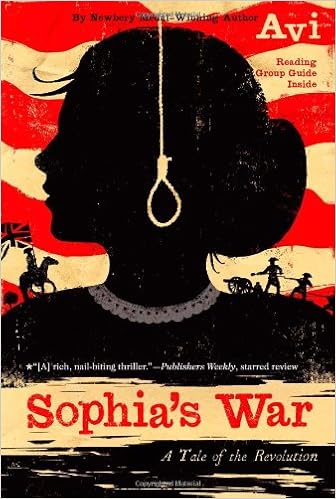
Blood on the River was such a huge success that I decided to stay with another US History book after Winter Break.  Sophia's War is a book largely about a fictional girl's involvement in the treason of Benedict Arnold.  This one had rave reviews on Amazon, so my colleague and I went for it.  But we both kinda gave it Two Thumbs Meh.  It was long, parts of it seemed to drag on forever, and we were both so impatient with the main character.  However, the students in both classes said that they loved it, and they couldn't stop talking about it.  What do teachers know, anyway?  I did like the text-to-text comparisons we were able to do between the main characters of this book and Blood on the River.  Plus, this book lent itself to a discussion of how history changes depending on who's writing it.  And Sophia's ridiculous tweenager crush on a man twice her age ended up helping my kiddos figure out that 5th graders shouldn't really be "dating" anyone.  So the drama that saved me was worth the read.  =)


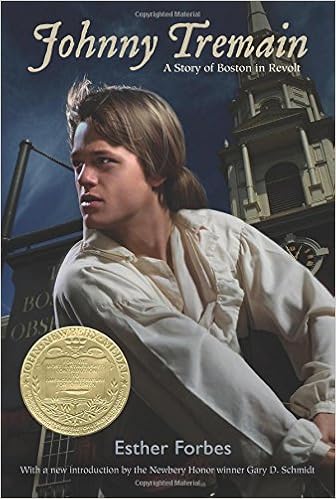
6. Johnny Tremain, by Esther Forbes


An oldie, but a goodie!  I read this one simply because I'd read it as a child, and Sophia's War really drove me nuts.  This book tells the story of a young silversmith apprentice who becomes involved with the Sons of Liberty, the Midnight Ride, the Boston Tea Party, and the battle of Lexington and Concord.  The kids loved it, I loved it, and it lent itself to great character debates.  Rab Silsbee became a hero in my room.  "Be Like Rab!" was a motto of ours for a while. I only wish I had read it before Sophia's War, because it does take place in an earlier time frame.


7.     Streams to the River, River to the Sea, by Scott O'Dell


At the end of the year, I wanted to spend time with the Lewis and Clark expedition, and this was the only novel I could find that covered it.  Sacagawea is the narrator, and I thought the story was so well told from her point of view.  I know there is criticism of the book because there is no documented proof that she and Clark had any kind of special friendship - but I just explained this to the kids as the story went on.  We had fun speculating whether or not it was true.  And everything else seems to coincide with Clark's journals.  We had many discussions about race relations in America in the early 1800s, and it was a powerful time for us.  I was, however, rushed to finish the book by the end of the year, so we didn't get as much out of it as I think we might have.  I'll plan a bit better for it next year!